 Today’s challenge is a very easy challenge from Hack the Box. You can find it here. There is no machine to start up, you just download the required files for the challenge. You’ll get a .zip file and the password they provide you is hackthebox.
(kali@vici)-[~/htb/spookypass]
$ unzip SpookyPass.zip
Archive:  SpookyPass.zip
   creating: rev_spookypass/
[SpookyPass.zip] rev_spookypass/pass password:
  inflating: rev_spookypass/pass
After unzipping it, we see that it unzipped a directory called rev_spookypass and that directory has a single file in it called pass. When we run the file command on pass, we see that is an executable and that it is not stripped.
(kali@vici)-[~/htb/spookypass]
$ ls
rev_spookypass  SpookyPass.zip

(kali@vici)-[~/htb/spookypass]
$ cd rev_spookypass && ls
pass

(kali@vici)-[~/htb/spookypass/rev_spookypass]
$ file pass
pass: ELF 64-bit LSB pie executable, x86-64, version 1 (SYSV), dynamically linked, interpreter /lib64/ld-linux-x86-64.so.2, BuildID[sha1]=3008217772cc2426c643d69b80a96c715490dd91, for GNU/Linux 4.4.0, not stripped
Since this is Hack the Box, we can be a little less cautious. However, if you find an executable in the wild, don’t just run it. The better play is to get it into a sandbox and run it there so that it can’t do any damage to your machine or VM on the chance that it is malicious. Warnings aside, here we go..
(kali@vici)-[~/htb/spookypass/rev_spookypass]
$ ./pass
Welcome to the SPOOKIEST party of the year.
Before we let you in, you'll need to give us the password: hackthebox
You're not a real ghost; clear off!
Okay. So, we need a password. The file command said that this binary executable is not stripped. What does that even mean? That means that the binary still contains its symbol table and possibly debugging information. The result is that:
- Function names, variable names, and other symbols are still embedded inside.
- It’s larger in size than a stripped binary.
- It’s easier to debug or reverse engineer (e.g., using gdb, objdump, or strings).
Okay, so now we are talking about some good stuff. Since this wants a password and it is checking, it is possible that the password is inside, unobfuscated, and accessible through some simple methods. I’m going to try strings first. What is strings? This description is from the man pages for strings.
DESCRIPTION
For each file given, GNU strings prints the printable character sequences that are at
least 4 characters long (or the number given with the options below) and are followed
by an unprintable character.

Depending upon how the strings program was configured it will default to either
displaying all the printable sequences that it can find in each file, or only those
sequences that are in loadable, initialized data sections.  If the file type is
unrecognizable, or if strings is reading from stdin then it will always display all of
the printable sequences that it can find.

For backwards compatibility any file that occurs after a command-line option of just -
will also be scanned in full, regardless of the presence of any -d option.

strings is mainly useful for determining the contents of non-text files.
What does that get us?
(kali@vici)-[~/htb/spookypass/rev_spookypass]
$ strings pass
/lib64/ld-linux-x86-64.so.2
fgets
stdin
puts
__stack_chk_fail
__libc_start_main
__cxa_finalize
strchr
printf
strcmp
libc.so.6
GLIBC_2.4
GLIBC_2.2.5
GLIBC_2.34
_ITM_deregisterTMCloneTable
__gmon_start__
_ITM_registerTMCloneTable
PTE1
u3UH
Welcome to the
[1;3mSPOOKIEST
[0m party of the year.
Before we let you in, you'll need to give us the password:
s3cr3t_p455_f0r_gh05t5_4nd_gh0ul5
Welcome inside!
You're not a real ghost; clear off!
;*3$"
GCC: (GNU) 14.2.1 20240805
GCC: (GNU) 14.2.1 20240910
main.c
_DYNAMIC
__GNU_EH_FRAME_HDR
_GLOBAL_OFFSET_TABLE_
__libc_start_main@GLIBC_2.34
_ITM_deregisterTMCloneTable
puts@GLIBC_2.2.5
stdin@GLIBC_2.2.5
_edata
_fini
__stack_chk_fail@GLIBC_2.4
strchr@GLIBC_2.2.5
printf@GLIBC_2.2.5
parts
fgets@GLIBC_2.2.5
__data_start
strcmp@GLIBC_2.2.5
__gmon_start__
__dso_handle
_IO_stdin_used
_end
__bss_start
main
__TMC_END__
_ITM_registerTMCloneTable
__cxa_finalize@GLIBC_2.2.5
_init
.symtab
.strtab
.shstrtab
.interp
.note.gnu.property
.note.gnu.build-id
.note.ABI-tag
.gnu.hash
.dynsym
.dynstr
.gnu.version
.gnu.version_r
.rela.dyn
.rela.plt
.init
.text
.fini
.rodata
.eh_frame_hdr
.eh_frame
.init_array
.fini_array
.dynamic
.got
.got.plt
.data
.bss
.comment
Anything look good in there? Absolutely! Between the string requesting the password and the string welcoming you in is this gem, “s3cr3t_p455_f0r_gh05t5_4nd_gh0ul5”. Let’s see if it works.
(kali@vici)-[~/htb/spookypass/rev_spookypass]
$ ./pass
Welcome to the SPOOKIEST party of the year.
Before we let you in, you'll need to give us the password: s3cr3t_p455_f0r_gh05t5_4nd_gh0ul5
Welcome inside!
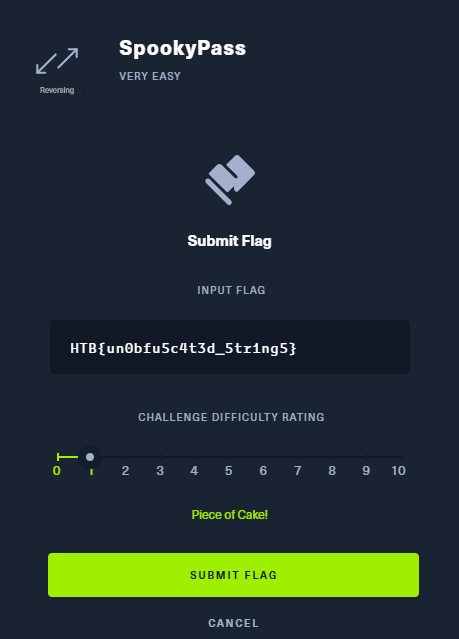
HTB{un0bfu5c4t3d_5tr1ng5}
And there we go. If we put that flag in over at Hack the Box, we win.
There we go! Very Easy, as promised. However, we did get some exposure to learning about unknown files and some very basic skills in prodding those files to see what might be hidden within them. Any questions, let me know in the comments!
